Cool Drawings for Tom Girls
Kickoff in 1985 Jones co-edited J.D.s, a photocopied serial publication, alongside Bruce LaBruce. Despite its ephemerality, for those in the know information technology had all the import of a sacred text. Like Full general Idea's FILE magazine before it, and Scott Treleaven'southward This is the Salivation Army after it, J.D.s was the quintessence of a strategy and tradition perhaps unique to Toronto'due south undercover self-publishing whereby a handful (at well-nigh) of isolated queers embellish their reality—promulgating ideologies and mythologies as if issued from a surging, numerous gang—and, in time and through force of spirit, produce cocky-fulfilling prophecies, alluring international attention and adding to the city's unlikely anarchic glamour. In the course of her early editorial duties (writing polemics, collaging), divine inspiration visited Jones: Wouldn't it be fabulous to publish all-female person versions of Tom of Finland'due south drawings? Those erotic vignettes, rendered in pencil with the panache of Ingres, of muscled policemen and bikers. Through a simple détournement, those drawings' fetish for the hyper-masculine and the authoritarian could become images of liberation in one case again, freed from the fascist tendencies at work in gay male culture. Jones had not yet added drawing to her vocations, and, as J.D.s preferred to operate inside Warholian parameters, her immediate impulse was to search for a suitable artist to whom she could outsource the job. Alas, and of form, no 1 could exist found. So she set well-nigh the task of transcription herself.
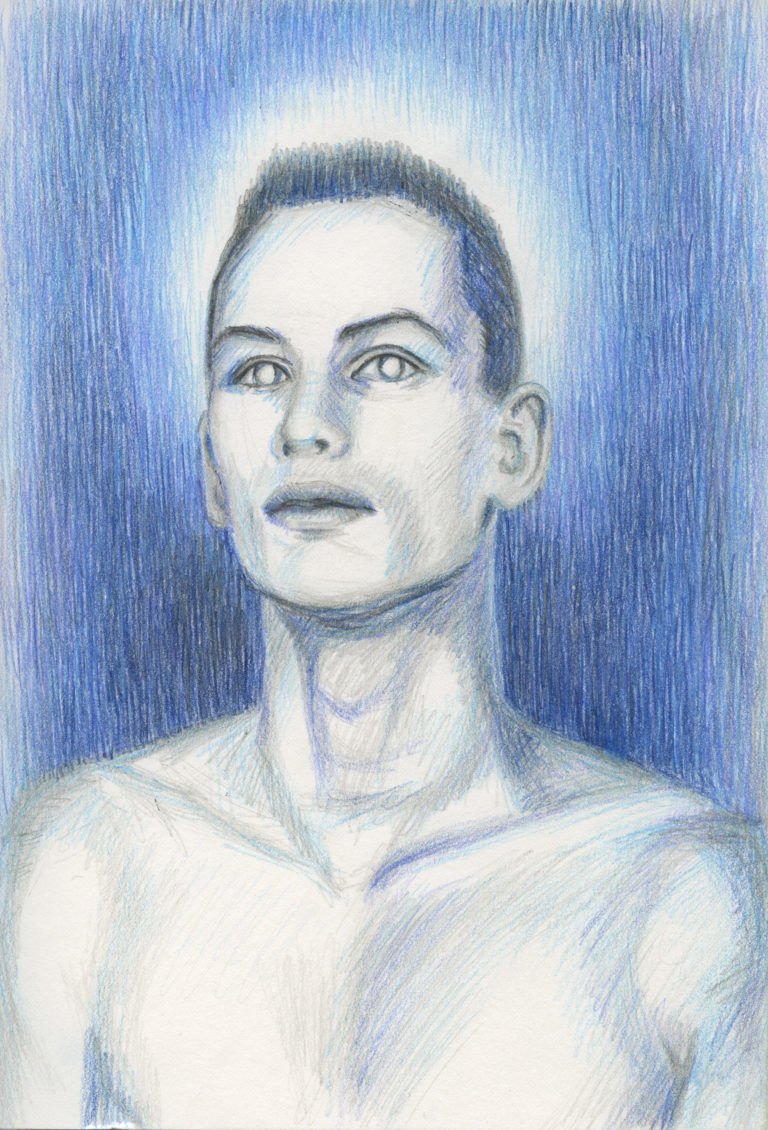 Thou.B. Jones, Blueish Mark Morrisroe, 2004. Graphite and coloured pencil on paper, 22.8 ten 16.5 cm. Courtesy the artist/ Participant Inc., New York.
It can exist said, with or without facetiousness, that Jones attended the Tom of Finland Schoolhouse of Cartoon. Just as 2 bodies might find one another across a room or a bar, a communion far more than formidable to the corroboration of character can occur over an area of fourth dimension and infinite—by way of aligned intentions—through art. During the centre of the night, at a kitchen table under an amber bulb, pencil in hand, beside an ashtray that clocked the hours with its crumpled contents, in this tranquillity realm began a serial Jones dubbed the Tom Girls, which was ultimately exhibited in galleries around the globe and remains a pertinent contribution to 3rd-moving ridge feminist art. In the course of those nights Jones came into possession of a drafting skill that is at once her own, but also the latest, and possibly among the last, iterations of a descendancy in guration—cartooning in the highest sense. From the late Renaissance mannerism of Cellini, through the decadence of Beardsley and wit of Cocteau, there owed a germ of style that nally proliferated over the concluding century as illustration in gay magazines, of which Tom was male monarch. Jones studied and replicated Finland's form and technique in service of her own agenda, observing the slick of polished leather, the curtain in denim to articulate strained tumescence, the penumbra necessary to a pert nipple that is both commanding and receptive. Jones is an appropriationist by conceit. Dissimilar some of her contemporaries and their Pop antecedents, she appropriates not ambivalently or ironically, but with sincerity; gay culture, for better or worse, is a part of her civilization, and her critique of Finland was enacted devotionally.
Classicism, a wellspring for homosexual expression up until the middle of the terminal century, had ballast that allowed for a complex play of innuendo; its translations into painting and literature were the mechanics and art of expressing homosexuality implicitly. A homosexual reader or viewer would nd themself deciphering its code, an intercourse arguably more asserting of departure than any explicit declarations of these desires might have been. Translation is not purely the feat of making legible that which was previously unavailable to a certain group. Its crux resides, when one considers the potential for multiple versions, in the pleasance of the reprise—a rendition motivated more than by the perceived sensibilities of a text than by its actualities. The verbosity of the first English language translation of Proust undertaken past C.G. Scott Moncrieff, for example, is a corruption of the author'southward more matter-of-fact French toward ameliorating its melancholic purpose: 1 homosexual picking up the baton lain at the feet of some other, to exist molded in the relay by their own circumstances and vision into an exquisite subjective. Finland flourished at the beginning of a new climate, and his images ricocheted. His men, bursting from the closet, were iconoclastic motifs picked upwardly by punk (namely, Vivienne Westwood and Malcolm McLaren) only as past leather subcultures. The history of translation, at its most interesting, is that of hijacked content and, by reimporting nuance, Jones's work serves this design.
Finland has only lately been metabolized by the gimmicky art world, and his work remains, in pop imagination, either the stuff of the gay roué or malignant kitsch. A Norwegian creative person recently recounted a different, personal story for me. At the time of his pubescence in the 1970s, Nordic progressives, in a moment of irreligious enlightenment, felt that Finland's drawings were edifying material for youngsters whose bodies were in transformation. Issued in volumes bachelor past Reader'south Digest–type subscription, Finland's drawings were left (along with volumes on Volition McBride) upon the depression shelves of suburban Nordic dens. Certainly this isn't the case anywhere anymore, but the anecdote is useful for contemplating the vagaries of taboo, and a scenario with which to imagine the discovery of Finland'south piece of work by other aesthetically minded lesbian adolescents.
When the Tom Girls made their New York debut in 1991, it was concurrent with an exhibition of Finland's drawings and sketches at the storied gallery Feature Inc., run by a human being named Hudson. Republic of finland was in the hospital and would die from emphysema later that year and Hudson was living with HIV. It is impossible to consider Jones's early fine art, or whatsoever art made by homosexuals during the 1980s and '90s, without the context of the AIDS crisis. It was a time during which Finland'southward utopia was either consigned to the flames by those disgusted and panicked by its wanton, egotistic bodies, or conversely, plant to be grossly superannuated, something on the other side of the chasm of before and after, like Norman Rockwell in the wake of Hiroshima. (Finland and Rockwell are artists with much in common: propagandists in service of patriarchy in whose work the police were, however differently, worshipped.) It was a time when homosexual civilisation was besieged past puritanism, assimilation and AIDS, and Jones, herself a young veteran of this war, perceived its smoldering apogee on the anterior horizon, and knew instinctively that the by was where the good stuff lay.
In plainest terms, Jones's art has ever been interested in ungovernable sexualities and genders, in intimate and defiant groups of queers and women, and in the history of aesthetics forged by those who were compelled to communicate and represent their alterity through sensibilities and codes. Although they function allegorically, it's of import to note that Jones's drawings are always revised images of those found in the media. When considered alongside her films, ever starring her friends, Jones'due south work is in conceptual sorority with the lesbian figurative painters Romaine Brookes and Gluck, who set confronting dusky hues the assertive countenances and sleeked hair of their lovers dressed in men's clothes.
During the xv years following the Tom Girls, Jones'south drawing spanned Caspar David Friedrich-esque landscapes, Ballardian motorcar-crash scenes, fetishistically realistic nevertheless-lives, and portraits. These portraits are of a cast of immature people—teenagers and teenage artists—all protagonists who, by turns of fate pertaining to criminalized sexuality, were ensnared in morbid and frequently terminal circumstances. In their faces Jones makes evident the centrifugal force of hormonal logic ring adolescent rebellion, those impulses that tin devolve from caprice into lunacy in an instant equally they confront societal strictures. Some portraits have a glow of hagiography— icons considering they are symbols of manipulation within a world of manipulation. Each has a definite story that reminds us that it was not long ago that all homosexuality was criminal, and moreover of the duality of criminalized bodies as oft being civilized bodies too. The true ideal of Culture is the pursuit of art and dazzler in a earth complimentary from all prudery, superstition, prejudice and cruelty. One cartoon, later a self-portrait by the photographer Marker Morrisroe—during his years as a hustler, and before his death from AIDS—is a film that emits something like a tinnitus ring in the psyche of queer artists, reminding them of their everlasting obligation to both ranks.
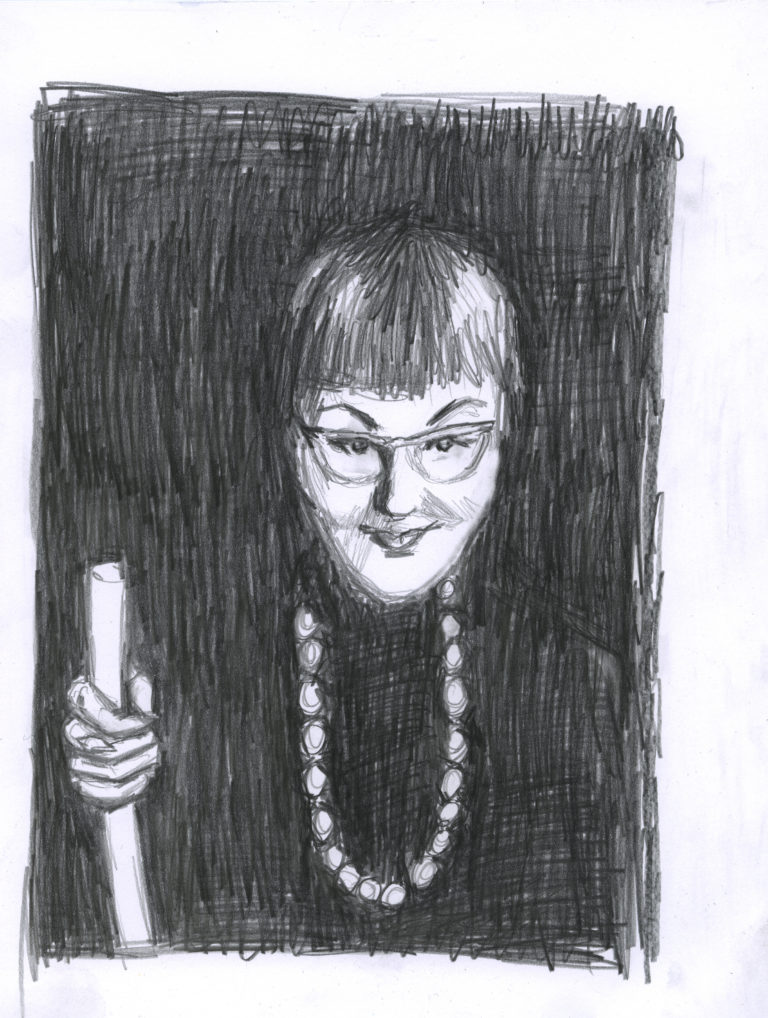 G.B. Jones, Doreen Valiente, 2017. Graphite on paper, 27.9 10 21.v cm.
Jones's latest series of drawings departs from Finland'due south meticulous end for an intuitive, loose and more rapidly rendered likeness. They are portraits of witches, both real personages and those from film and tv set. Almost all are women, and most are middle-anile. To their disregarded demographic Jones gives aspects of indomitability, from dandyish insolence to an air of consequential power. She re-imbues their well-circulated images from popular and occult civilization with a sense of life. There is Agnes Moorehead as Endora from Bewitched; Joan Bennett in her final pic role every bit Madame Blanc; Doreen Valiente, Wiccan liturgist and author; Rosaleen Norton, an occultist, artist and leader of her own coven. Their energy and image defies the sublunary, workaday world of men, and it is interesting to consider them as Jones's symbolic milieu.
The middle-aged protagonist in Nancy Mitford'due south novel Don't Tell Alfred (1960), unsatisfied by family life, wonders, "What was I doing on earth at all and how was I going to fill in the thirty-odd years which might lie ahead before the grave? …I had often longed to go out behind me a token of my beingness, a shell on the seashore of eternity." Though Jones's subjects refuse existential crunch, society however perceives them as beyond their use-value, and therefore invisible; in spite of information technology they make invisibility their prowess. Literary theorist Leo Bersani wondered, in Homos (1995), if the visibility gays had gained through assimilation would paradoxically atomic number 82 to invisibility: "The slogan 'We are everywhere' appears to be saying: 'Look around and y'all'll find us in all the places to which you thought you had denied united states of america access.' Just the slogan could as well have a quite different gloss: 'Look around and yous'll never observe us considering we are everywhere…even if we do the most outrageous things…nosotros will remain unlocatable.'" If, in our retrograde present, as progress welds society together to serve its ends, queers come up full circle to the invisibility where the mature woman has e'er dwelt, and then Jones's witches posit 2 crucial things: the potential for all of us to go Fifth Columnists; and a reminder that feminism must e'er be an exigency of queer politics, only as we must empathize that homophobia is an extension of misogyny.
The Canadian art globe has so far allotted Jones that which is broadly accorded to those of her gender and generation; elsewhere her importance is recognized. In her manifold means, Jones displays queer genius; like Cocteau, she has moved forth her era with an aesthetic that appears prescient, but is in fact of-the-moment. From the ruins of gay liberation, over the bulkhead of late-capitalist gay commodification, beyond the cloy of nostalgia, through the condensed temper of identity politics, she sees our perpetual aim: the resurgence of homosexual fine art, a 2-pronged weapon—one fork, visual pleasance, the other, transgressive pleasure.
Source: https://canadianart.ca/essays/tom-girls/
0 Response to "Cool Drawings for Tom Girls"
Post a Comment